RV water pump repair in Phoenix
The 12-volt pump is what gives you water when you're not on a city hookup. When it buzzes, chatters or goes quiet, the cause is usually upstream of it — the tank, the strainer or the power.
The tech drives out to wherever the RV sits — at home, in storage or at an RV resort.
What it's doing
- Runs, but no water comes out
Empty fresh tank, a closed valve, a clogged inlet strainer, or air getting in on the suction side.
- Turns on by itself every few minutes
Water is escaping somewhere — a dripping faucet, a leaking fitting, the toilet valve — or the pump's own check valve is worn.
- Won't run at all
A blown fuse, the pump switch, a low house battery, or a failed pressure switch or motor.
- Pulses or sputters at the faucet
Often a partly clogged strainer or aerator, or a pump that needs an accumulator tank to smooth the flow.
- Weak pressure at every faucet
A clogged inlet strainer, a worn pump or a kinked line under a cabinet. If only one faucet is weak, its aerator is usually full of scale.
- Toilet won't hold water
The seal around the flush valve is dry or dirty. A small leak at the foot pedal or water inlet also shows up as a pump that cycles.
Checks you can do
- Water in the tankTank sensors are often wrong. Look at the tank or open the low-point drain for a second.
- Valves and bypassMake sure the tank outlet valve is open and that winterizing valves are back in their normal position.
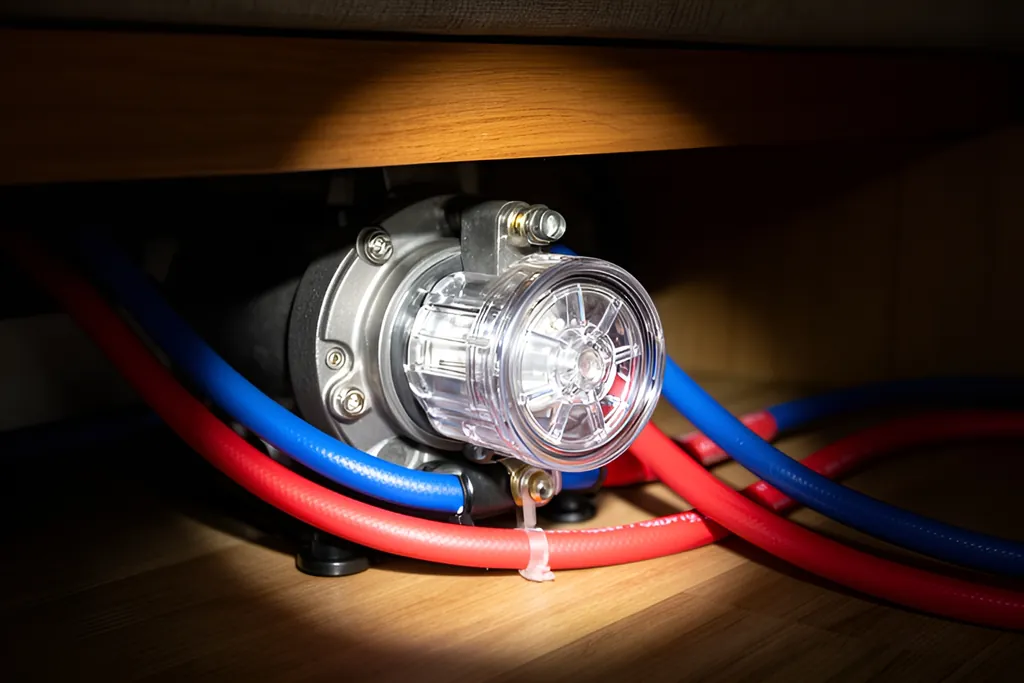
- The strainerMost pumps have a clear strainer bowl on the inlet. Shut the pump off, unscrew the bowl, rinse the screen and put it back hand-tight.
- Fuse, switch and batteryCheck the pump fuse in the 12-volt panel and try the pump switch in another spot if you have two.
- On city waterYou don't need the pump at all — turn it off. Use a pressure regulator at the spigot; park water pressure can run high enough to stress RV fittings.
What the technician does
They check voltage at the pump, test the pressure switch and the check valve, and pressure-test the lines to find a leak you can't see. Most RV pumps are rebuildable or cheap enough to replace outright; the tech will tell you which makes sense.
Hard water matters here too. Scale from the Valley's tap water builds up in strainers, faucet aerators and the check valves of pumps and toilets, so a tech will often clean those while they're in there.
What it costs
| Job | Usual cost | Where the number comes from |
|---|---|---|
| Simple leak repair | about $100 | Camping World, “Mobile RV Repair Cost Guide”, July 2026 |
| Plumbing repair, general | $100–1,000+ | Camping World, “Mobile RV Repair Cost Guide”, July 2026 |
| Technician's hourly rate | $140–200 | Micro-Air, “How much does it cost to replace an RV AC unit”, June 2026; Camping World, “RV Furnace Repair Cost Guide”, October 2026 |
Ballpark for 2026, not a quote. The technician sets the actual price after looking at your RV.
A new 12-volt pump itself is a modest part; most of the cost is time spent finding the leak or getting at the pump under a bench or bed.
Numbers last checked November 2026.
Owners also ask
Should the water pump switch be on all the time?
Only when you're using the fresh tank. On a city hookup, keep it off. When you leave the RV, turning it off means a small leak can't empty the tank onto the floor.
Is there a reset button on an RV water pump?
Usually not. If it stopped, check its fuse and the switch. Some pumps have a thermal cutoff that resets once the motor cools.
How do I know the pump is going bad?
It runs longer to build pressure, gets louder, cycles with every faucet closed even after you've checked for leaks, or hums without moving water.
Why does my RV toilet not hold water?
The rubber seal around the flush ball is dry or has grit on it. Cleaning and conditioning the seal often fixes it; a worn seal is a small part.
Get a mobile tech
Only your phone number is needed. Whichever tech picks up the job phones you.